
Start here
Understand the workspace, navigation, organization scope, and recommended learning order.
- Platform map
- Accounts and roles
- Navigation basics
DentalXpand learning center
Learn the platform workflow by workflow, from your first login to specialist RCM, credentialing, HR, finance, growth, administration, and Xpand AI.
Complete platform curriculum
Each track will grow into focused lessons for the actual roles, screens, decisions, and verification steps used in DentalXpand.
Understand the workspace, navigation, organization scope, and recommended learning order.
Learn the shared daily workspace used to plan, discuss, and complete operational work.
Operate practice, DSO, billing-company, provider, and client access with the right scope.
Follow verification, billing, claim, and accounts-receivable workflows step by step.
Learn provider-data collection, payer cases, documents, follow-up, and client reporting.
Teach the people workflows behind teams, attendance, time, leave, loans, and hiring.
Explain authorized expense, revenue, reporting, and practice-context workflows.
Cover lead research, outreach, calling, ownership, and pipeline follow-up.
Teach users, roles, practices, organization settings, and tenant-aware access boundaries.
Use Xpand AI and focused automation within the current role and organization context.
Complete feature inventory
Every current DentalXpand screen and complete user workflow now has a permanent place for its website lesson, screenshots, verification steps, and branded PDF.
See how organizations, practices, roles, and product areas fit together before feature-specific training.
Use the correct DentalXpand sign-in flow and understand what happens after authentication.
Complete first-login password setup, required password changes, and administrator-assisted resets.
Confirm which organization, practice, and tenant boundary applies before opening or changing records.
Use the responsive sidebar, expandable sections, active-page cues, and personal pinned shortcuts.
Learn why pages differ by role and how page permissions protect direct links as well as navigation.
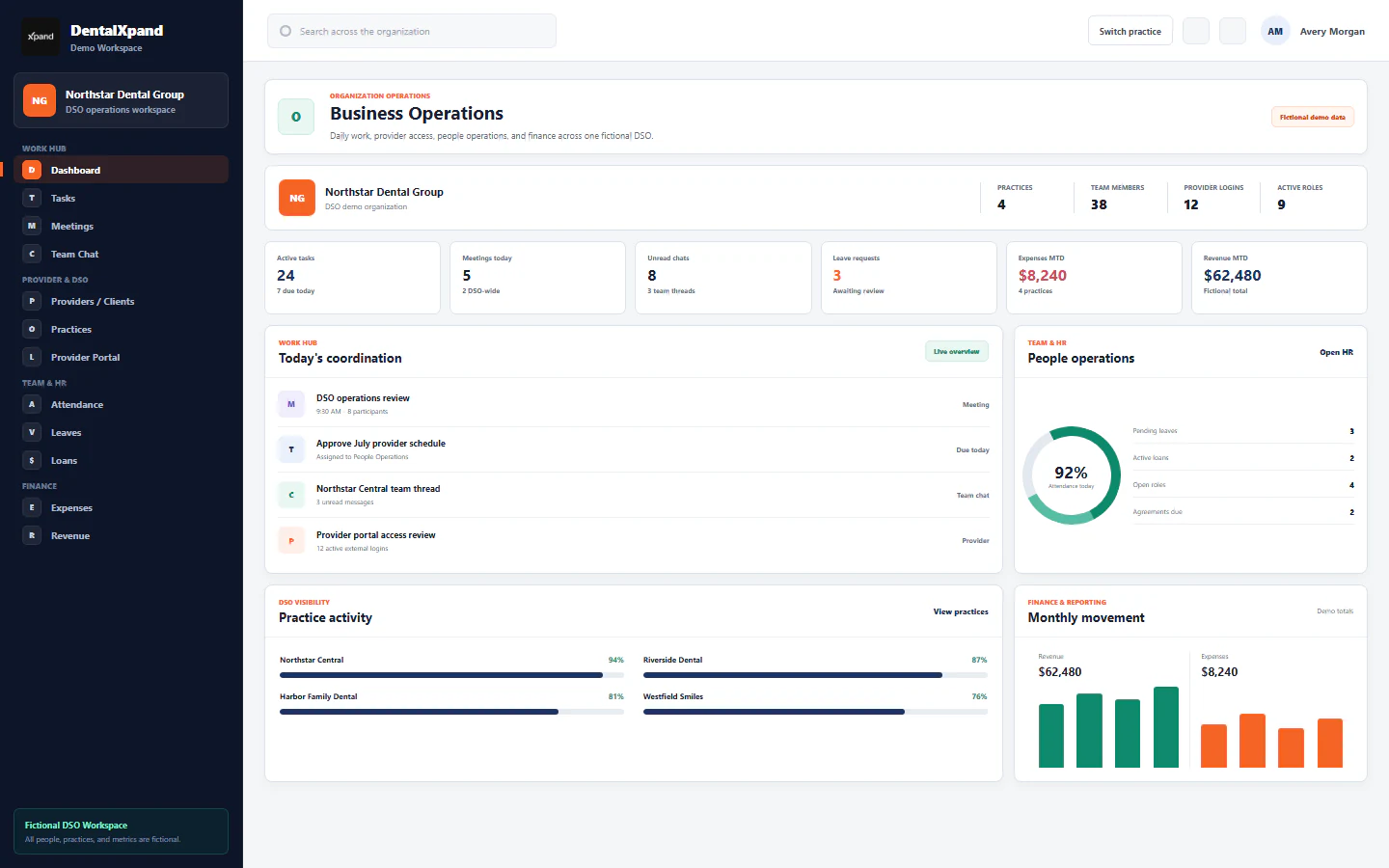
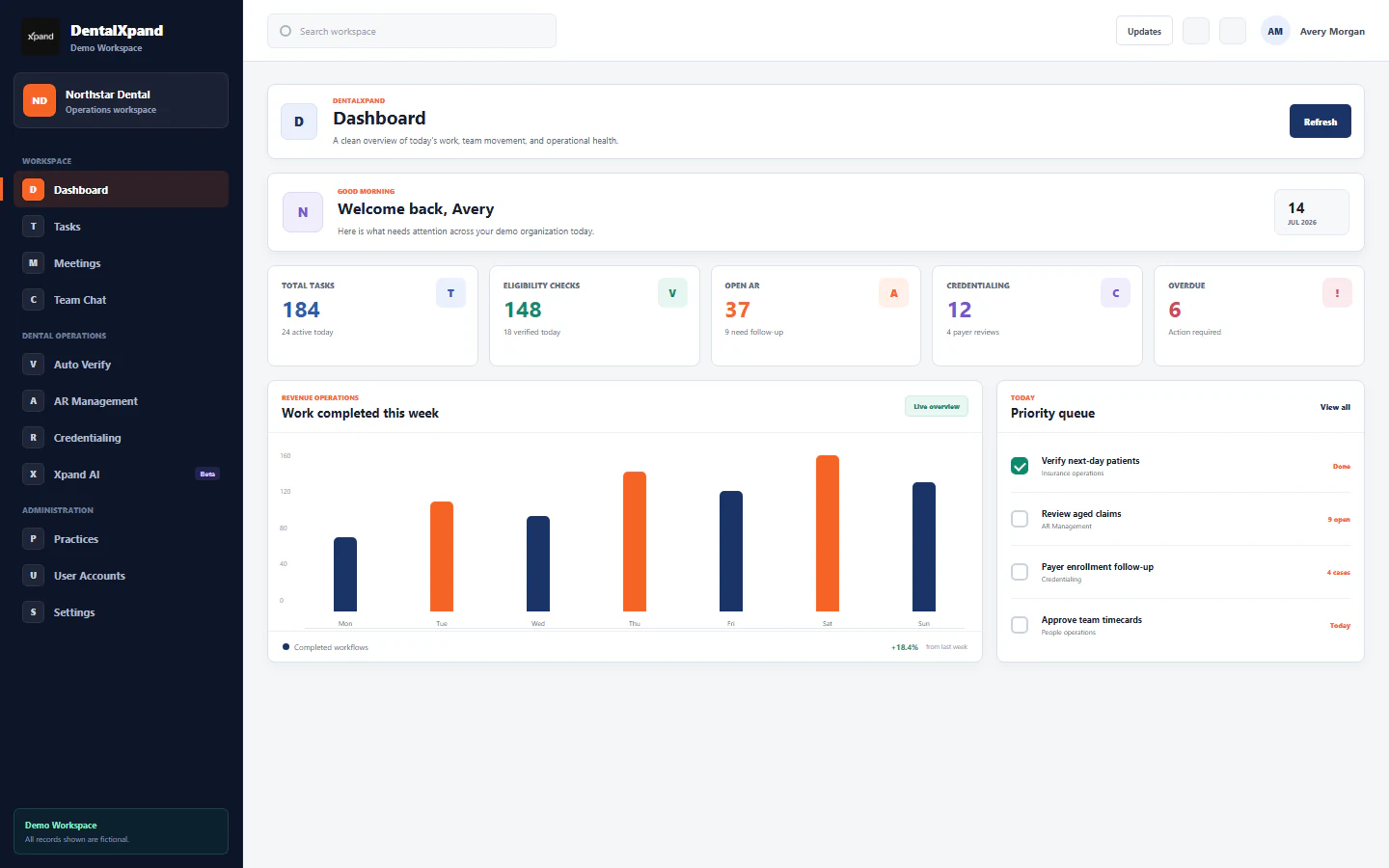
Read operational signals, workload summaries, quick actions, and role-specific dashboard information.
Create, assign, prioritize, track, discuss, and complete work with structured task steps and time logs.
Create meetings, invite participants, use calendar and list views, and track attendance status.
Join real-time calls, manage camera and microphone controls, and share a screen safely.
Start direct or group conversations, use current image uploads and voice notes, and manage unread activity.
Review alerts, mark activity read, and control browser or desktop notification delivery.
Upload, organize, preview, download, and remove workspace files according to permissions.
Create durable client instructions, track versions, and use structured options in assigned workflows.
Review and update permitted account and employee profile information without changing protected admin fields.
Ask for help, submit workplace feedback, and use the persistent quick-support experience.
Create and maintain provider or client records, operational contacts, status, and practice relationships.
Set up practice records and control which users and providers can work inside each practice.
Sign in as a provider or client and use the focused portal navigation available to external roles.
Connect provider users to the correct organization and practice without exposing another client workspace.
Move between practices, compare operations, and keep shared and practice-specific work correctly scoped.
Prepare, store, track, and manage Business Associate Agreements and client service agreements.
Apply organization identity, logos, colors, and client context without crossing tenant boundaries.
Work assigned accounts-receivable follow-ups, document outcomes, and move each account to its next action.
Filter AR records by date and aging, review risk groups, and export operational reports.
Navigate the medical billing workspace for eligibility, claims, remittance, follow-up, and supporting PDFs.
Connect Claim.MD, locate payer information, and run authorized eligibility searches.
Search remittance data, pull batches, generate supporting PDFs, and preserve follow-up history.
Enter benefit information carefully, verify the result, and generate a client-ready report.
Upload a source PDF, extract mapped information, review every field, and finish the VOB workflow.
Submit eligibility checks, review payer evidence and AI assistance, use audit history, and export verified results.
Run approved AR automation while preserving ownership, evidence, and human review of next actions.
Understand how DentalXpand connects payer lookup, eligibility, claim-status, and evidence responses.
Learn the two-page credentialing operating model, dashboard signals, ownership, and payer case flow.
Give providers a focused view of assigned credentialing requests, missing items, and progress.
Complete the provider profile, identifiers, education, disclosures, banking, and signature information.
Upload, classify, review, and maintain provider documents used across payer cases.
Create payer requests, apply state and request-type requirements, assign owners, and plan follow-up.
Review disclosures, map answers and documents, generate a payer packet, and resolve validation issues.
Record email, fax, portal, mail, and manual submissions and keep follow-up evidence in one timeline.
Share a clear client-facing view of cases, status, follow-up, and outstanding requirements.
Create teams, assign members and leads, and connect daily work to the right operating unit.
Find colleagues, roles, departments, and approved contact information.
Create and maintain employee profiles, assignments, compensation context, and employment status.
Track daily attendance and let authorized managers review hours, lateness, overtime, and payroll signals.
Start and stop task timers, preserve time entries, and review daily or period totals.
Understand active tracking, periodic screenshots, activity signals, access, and retention responsibilities.
Request leave, attach support, follow the approval chain, and review balances and calendar views.
Submit a loan request and track recommendation, approval, installments, disbursement, and completion.
Move applicants through recruitment, score structured evaluations, and record leadership recommendations.
Maintain positions, departments, interview questions, and scoring limits used by recruitment.
Prepare agreement forms, generate documents, and preserve signed employment records.
Issue, review, revoke, and archive formal employee warning or appreciation notices.
Record expenses, attach receipts, and complete approval or rejection with clear ownership.
Track revenue sources, clients, invoices, payment state, and operating-period totals.
Filter authorized management data, interpret operational metrics, and export CSV or PDF reports.
Find relevant business leads from approved sources and preserve search context and ownership.
Start approved scraping jobs, monitor progress, review local history, sync results, and export leads.
Review lead records, edit business details, apply tags and signals, and compare geographic context.
Move leads through call stages, record outcomes and notes, and schedule the next follow-up.
Authorize Gmail sending, prepare compliant outreach, and preserve recipient, content, and delivery history.
Create synchronized meetings and maintain approved website or knowledge sources for outreach assistance.
Create users, assign role and practice context, update status, reset passwords, and remove access safely.
Create organization roles, protect system roles, and maintain clear responsibility boundaries.
Grant only required pages and verify that hidden navigation and direct URLs enforce the same decision.
Manage personal and organization settings, display preferences, desktop downloads, and integration configuration.
Work with authorized organization data and secure internal records without exposing client-restricted information.
Review DentalXpand SaaS organizations, subscriptions, usage signals, and platform-level operations.
Create a tenant, establish its owner, configure initial access, and handle owner password resets.
Maintain plan definitions and control tenant subscription, suspension, and access state.
Send platform notices and open reason-documented, time-limited tenant support access.
Review and run authorized user or client synchronization while preserving organization mapping and failures.
Export approved system data, import carefully, and understand recovery and environment boundaries.
Apply least privilege, protect credentials, review audit evidence, and respond to suspected access issues.
Start a conversation, ask a focused operational question, and review answers before acting.
See how role, organization, provider, employee, verification, and knowledge context shape an answer.
Attach supported images or documents, review extracted text, and keep sensitive information inside approved workflows.
Understand local and remote deployment modes, connection status, and administrator-controlled model settings.
Review locally remembered conversations, start a clean chat, and understand device and workspace retention.
Understand sanitized review records, human approval, and controlled promotion to retrieval or model material.
Understand the approved knowledge collections that support product and practice-management answers.
Convert difficult names, identifiers, and call details into clear phonetic spelling for payer conversations.
A repeatable teaching model
Understand the purpose, permissions, data boundary, and screen structure.
Follow a realistic workflow with the exact decisions and fields that matter.
Confirm the expected result, visibility, ownership, and next action.
Guide library
Use the authorized Documents library, search and type filters, grid and list views, administrator uploads, in-app previews, signed file links, file actions, storage scope, and tenant-safe incident handling.
Open guideCreate and maintain per-client instruction PDFs with source-accurate type and software options, current-version behavior, inline signed previews, task-linked access grants, archive discipline, and tenant-safe handling.
Open guideMaintain permitted name, phone, avatar, and password details; understand protected employment fields, role-aware summaries, personal task and HR records, management controls, session behavior, and tenant-safe troubleshooting.
Open guideUse the persistent Quick Hub for focused messages, page-aware Xpand AI, safe screen snapshots, feedback and support requests; create and track full Support Hub tickets, understand anonymity, and resolve records within role and tenant boundaries.
Open guideCreate, find, review, edit, archive, and prepare provider or client records for login while preserving linked employee records, practice assignments, sensitive identifiers, action permissions, and tenant boundaries.
Open guideSet up practice records and control which users and providers can work inside each practice.
Open guide planSign in as a provider or client and use the focused portal navigation available to external roles.
Open guide planConnect provider users to the correct organization and practice without exposing another client workspace.
Open guide planMove between practices, compare operations, and keep shared and practice-specific work correctly scoped.
Open guide planPrepare, store, track, and manage Business Associate Agreements and client service agreements.
Open guide planApply organization identity, logos, colors, and client context without crossing tenant boundaries.
Open guide planWork assigned accounts-receivable follow-ups, document outcomes, and move each account to its next action.
Open guide plan